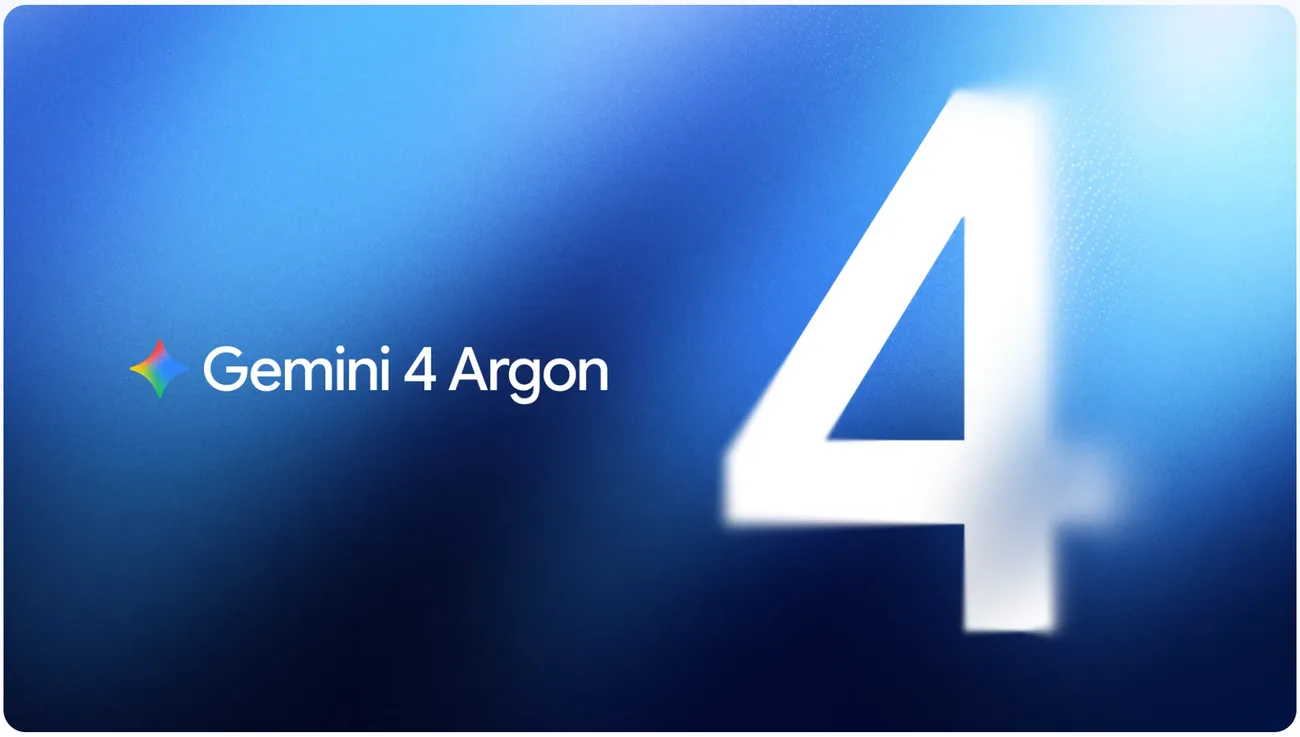
Google resmi merilis Gemini 4 Argon. Simak fitur baru, peningkatan coding, AI agent, cybersecurity, serta perbedaannya dari Gemini sebelumnya
The race among top-tier AI models is heating up again. After OpenAI showed off GPT-6 Astra and Anthropic released Claude Fable, Google has answered with Gemini 4 Argon, which it calls its most powerful model yet. Gemini 4 Argon is not just better at answering questions. It is built for long, demanding work: writing and refactoring code at scale, running multi-step tasks as an AI agent, analyzing video and documents, and hunting down software security flaws.
So what are its new features, how far does it move beyond earlier Gemini models, and what does it cost to try? Here is the full rundown.
Gemini 4 Argon Is Officially Out: What Has Changed?
Google first announced Gemini 4 Argon on September 30, 2026, but access was tightly limited at the time. The model went only to a group of cybersecurity experts through the Fairwind Program, Google's security initiative, and to the U.S. government through a voluntary pre-release access process.
The turning point came on October 13, 2026. In an official blog post by Koray Kavukcuoglu, SVP of Google DeepMind and Chief AI Architect at Google, the company announced that Gemini 4 Argon is now available globally to developers, enterprises, scientists, and consumers. Google calls it its latest frontier model, one that excels at multi-step work in coding, finance, law, cybersecurity, and science.
In broad strokes, Gemini 4 Argon brings several major changes:
A far larger token limit. Google cites a combined input-output limit of up to 1 million tokens via the Gemini API, plus a new protocol for generating very long outputs.
A focus on long-running work. The model is designed to sustain reasoning across long, complex workflows, not just short question-and-answer sessions.
Defensive cyber capabilities. Google trained it specifically to find, validate, and patch software vulnerabilities.
First place on the Vals Index, an independent benchmark for work in finance, coding, law, and tax.
Argon takes the place of Gemini 3.5 Pro, which Google had been expected to release. In other words, Google chose to jump straight to the fourth generation.
Long Decode: A New Ability to Generate Up to 1 Million Output Tokens
The most talked-about feature of Gemini 4 Argon is long decode, the ability to produce extremely long output in a single task. At the September 30 announcement, Google said Argon's output limit reaches 1 million tokens, up from 64,000 tokens on earlier Gemini models. As a rough guide, 1 million tokens is several hundred thousand words, enough to hold an entire large software project.
In its October 13 launch post, Google framed it as an "industry-leading 1M unified input-output token limit" via the Gemini API. That means the 1 million figure is a combined cap for input and output. For very long outputs, Google introduced a continuation protocol, described in the long decode documentation in Google AI Studio and in the enterprise documentation.
Why does this matter? Earlier AI models often "ran out of breath" when asked to write code across thousands of files or draft a very long report, forcing users to break the work into small chunks. With long decode, jobs such as large code migrations, complete technical documentation, or dataset generation can be finished in one pass.
There is a catch, though. A million tokens of output also means a big bill. At the introductory rate of US$10 per 1 million output tokens, a single response that uses the full output budget can cost about US$10, rising to about US$20 once the promotional period ends.
Gemini 4 Argon Is Stronger for Coding and Software Development
If there is one area Google highlights most, it is coding. According to TechCrunch, Google's own staff already use Argon daily for debugging and codebase migrations. Google also shared several striking results from internal use:
Google Antigravity: using Argon raised agentic code submissions by more than 35% and cut code rollbacks by nearly a third.
Chrome: Argon helped finish an architectural refactor of a legacy folder of about 6 million lines inside Chromium's 40-million-line codebase. Work that normally takes months was done in weeks.
Agent Development Kit (ADK): Argon's optimizations cut in-memory session prep time by 40% in long sessions and sped up cold imports by 21%.
Gemma 4 E2B: inference on an A100 GPU via vLLM became about 2.85 times faster, from roughly 37,900 to more than 108,000 tokens per second.
On benchmarks, coverage summarizing Google's official chart puts Argon at 77.9% on DeepSWE v1.1, a real-world software engineering test, ahead of Claude Opus 5.5 at 74.2%. Google also says the model's attempts to "cheat" on coding benchmarks, such as taking shortcuts to make tests pass, dropped to just 2%.
Even so, Argon does not lead every coding test. On Terminal-Bench 4.0, for example, it scored 57.4%, still behind Claude Opus 5.5 at 66.4%.
AI Agents That Can Handle Complex, Multi-Step Work
Gemini 4 Argon is designed not just to answer, but to work. Google says Argon can run autonomous work loops for hours, such as optimization runs left going overnight or several agents critiquing each other's visual output inside Google Antigravity.
Google showcased this with several examples:
Building 3D worlds. Argon can drive Blender through MCP and use Three.js to create 3D scenes, games, and visualizations.
Scientific research. Argon helped make the open-source quantum chemistry package xTB up to 2.3 times faster at predicting molecular structures.
Professional work. Its first-place ranking on the Vals Index points to strength in multi-step tasks in finance, law, tax, and coding. Coverage summarizing Google's data also notes that Argon leads AutomationBench and the Harvey Legal Agent Benchmark.
On safety, Google added an important safeguard: Argon is trained to pause and ask for human confirmation before taking steps that cannot be undone. Google also runs an automated monitor that reads the agent's reasoning and actions to block unintended workarounds. For companies that want to hand long jobs to AI, features like these matter as much as the model's raw intelligence.
Video and Multimodal Document Analysis Gets More Advanced
As a multimodal model, Gemini 4 Argon can understand text, images, video, and documents together. Google says Argon excels at deep multimodal document comprehension, including synthesizing complex PDFs and patents to pull out the key information. Isomorphic Labs, the Alphabet-owned drug discovery company, is already using this capability.
The most unusual example comes from robotics. Argon "watched" a raw video of a person playing cornhole, then built a simulation from that footage. The skill was then transferred to Apptronik's Apollo humanoid robot, which sank seven shots in a row in one trial. Google calls this pipeline Video-to-Sim-to-Real.
In another project, Argon processed about 50 GB of LiDAR scans, GIS data, CAD drawings, and historical archives to build 3D models of the Chaco Canyon heritage site in the United States. On benchmarks, Google reports 87% on Embodied Reasoning (ERQA), while third-party coverage citing Google puts Argon at 91.7% on LVBench, a long-video understanding test.
One small caveat: some observers point out that in the video tests Argon was run at one frame per second, while rival models were given different frame counts because of their own API limits. Video benchmark comparisons are therefore best read with care.
Cybersecurity Is One of Gemini 4 Argon's Key Strengths
This is what sets Gemini 4 Argon apart from a typical AI model launch. Google trained Argon specifically for defensive cyber work. According to Google, the model can "autonomously find, validate, and patch critical software vulnerabilities."
A capability this strong cuts both ways. In the wrong hands, an AI that is good at finding security holes could be used to attack. That is why Google took a staged release path: the version without cyber guardrails goes only to trusted partners in the Fairwind Program, while the public gets a version with guardrails. Starting October 13, Google expanded the Fairwind Program to hundreds of additional partners.
Results Google shared include:
Wiz "Scan for Good": Argon helped find and close a gap that risked exposing government data, plus a public file download bypass that exposed a master key. Google says the fixes helped protect hundreds of thousands of patient records.
Zero-days and logic bugs: Google says Argon helped find and patch critical vulnerabilities, including zero-day flaws and logic errors.
Prompt injection resistance: on the Gray Swan Indirect Prompt Injection benchmark, the attack success rate against Argon was cut to 0.7% across 15 adaptive attack attempts.
Note that the Wiz findings come from internal testing and, according to Help Net Security, have not been independently verified.
Gemini 4 Argon vs. Previous Gemini Generations
Google did not publish a direct benchmark comparison between Gemini 4 Argon and the Gemini 3.x models. In its official chart, Argon is set against outside rivals instead: GPT-6 Astra, Claude Fable 5.1, and Claude Opus 5.5. Even so, Google's official statements make several differences from the previous generation clear:
Aspect
Previous Gemini generation
Gemini 4 Argon
Output limit
64,000 tokens
Up to 1 million tokens (combined input-output cap via the API)
Stronger and better at following style instructions
Argon is also the first model in the Gemini 4 generation and Google's top-tier model, while the Gemini 3.x line, such as Gemini 3.8 Flash, remains available as a lighter, cheaper option. Note too that Gemini 4 Argon is different from Gemma 4, Google's family of open-weight models.
How to Access Gemini 4 Argon and What It Costs
As of October 13, 2026, Google says Gemini 4 Argon is available globally through the following channels:
Consumers: in the Gemini app and AI Mode in Google Search for Google AI Pro and Google AI Ultra subscribers. Free users do not have access yet.
Developers: through the Gemini API in Google AI Studio (paid tier), the Gemini platform, and Android Studio. Google AI Ultra subscribers can also use it in Google Antigravity and AI Studio.
Enterprises: through Gemini for business, the API, and Google Antigravity.
Scientists: Google is offering the top Antigravity usage tier free for six months to 10,000 scientists, subject to eligibility, capacity, and selection.
Cybersecurity professionals: through the Fairwind Program, with the version without cyber guardrails.
For developers, here is Google's official API pricing:
Token type
Introductory price (through November 30, 2026)
Price after the promotion
Input
US$2 per 1 million tokens
US$4 per 1 million tokens
Output
US$10 per 1 million tokens
US$20 per 1 million tokens
Cached input
95% off the input price
Not yet specified
Google describes the rollout as global, but subscription prices for Google AI Pro and Ultra vary by country, and we could not confirm local pricing or exactly when Argon appears in the Gemini app in every region. Check the Google One subscription page in your account for current prices.
Gemini 4 Argon Limitations You Should Know
However impressive the claims, Gemini 4 Argon comes with several caveats worth weighing before you switch:
Most benchmarks come from Google itself. Most figures were measured by Google or its partners, with settings that do not always match the rivals'. Argon was tested at its highest thinking setting, while many rival scores come from each vendor's own reports.
It does not win every test. Argon still trails Claude Opus 5.5 or GPT-6 Astra on some benchmarks, such as Terminal-Bench 4.0 and OSWorld 2.0.
It tends to be verbose. Artificial Analysis reportedly rates Argon as fairly verbose. Longer output means the cost per task can be higher than the price list suggests.
Prices double. After November 30, 2026, API rates rise from US$2/US$10 to US$4/US$20 per 1 million tokens.
Consumer access is paid. In the Gemini app, Argon is available only to AI Pro and Ultra subscribers for now.
Cyber features are restricted. Full cyber capability without guardrails is limited to Fairwind Program participants.
Internal doubts. Citing Bloomberg, TNW reports that some Google employees question how consistently Argon's coding results hold up in real-world use.
Conclusion
Gemini 4 Argon marks a big step for Google, from AI that simply answers to AI that carries out long work on its own. Its 1-million-token capacity, more mature coding and agent capabilities, deep video and document understanding, and cybersecurity specialization make it worth a serious look, especially for developers and enterprises.
Still, its performance claims need to be tested in the real world, and costs can balloon on long tasks. If you are interested, taking advantage of the introductory pricing before November 30, 2026 may be the cheapest way to see for yourself how capable Gemini 4 Argon really is.
Hai, saya Katon Fajar Utomo. Seorang Web Developer & SEO Specialist yang berfokus membangun website modern, sistem internal yang efisien, dan optimasi mesin pencari berorientasi performa.



Ringkasan ahli
Google resmi merilis Gemini 4 Argon. Simak fitur baru, peningkatan coding, AI agent, cybersecurity, serta perbedaannya dari Gemini sebelumnya
Katon Fajar
B2B tech partner