Project Detail

Development of the SPRINT35 Campaign Landing Page and Registration System

2026 • IT Training, Professional Certification, Education & Professional Development, Digital Campaign • Aug 08, 2026
Web & App Development Business Website & Landing Page
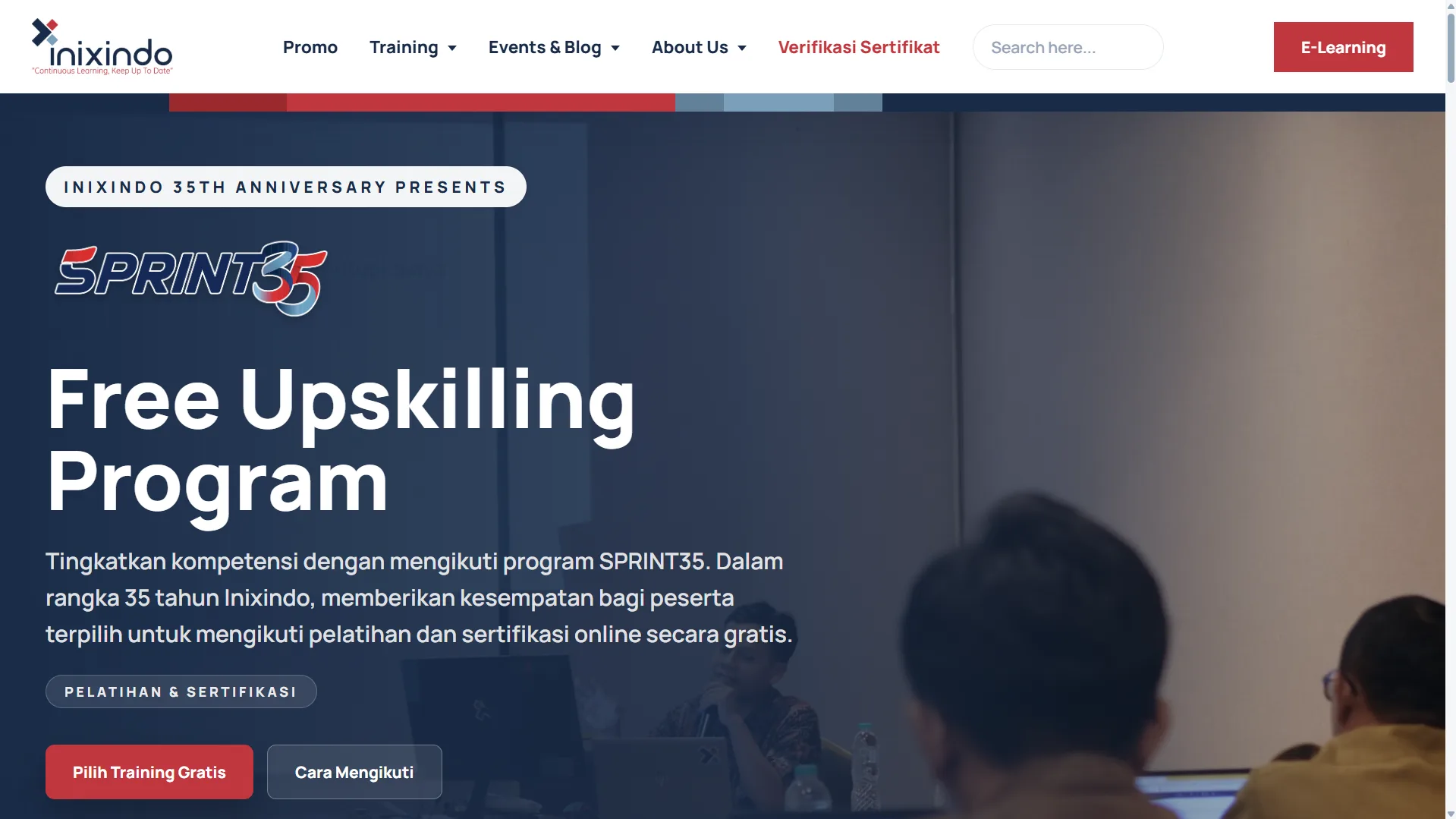
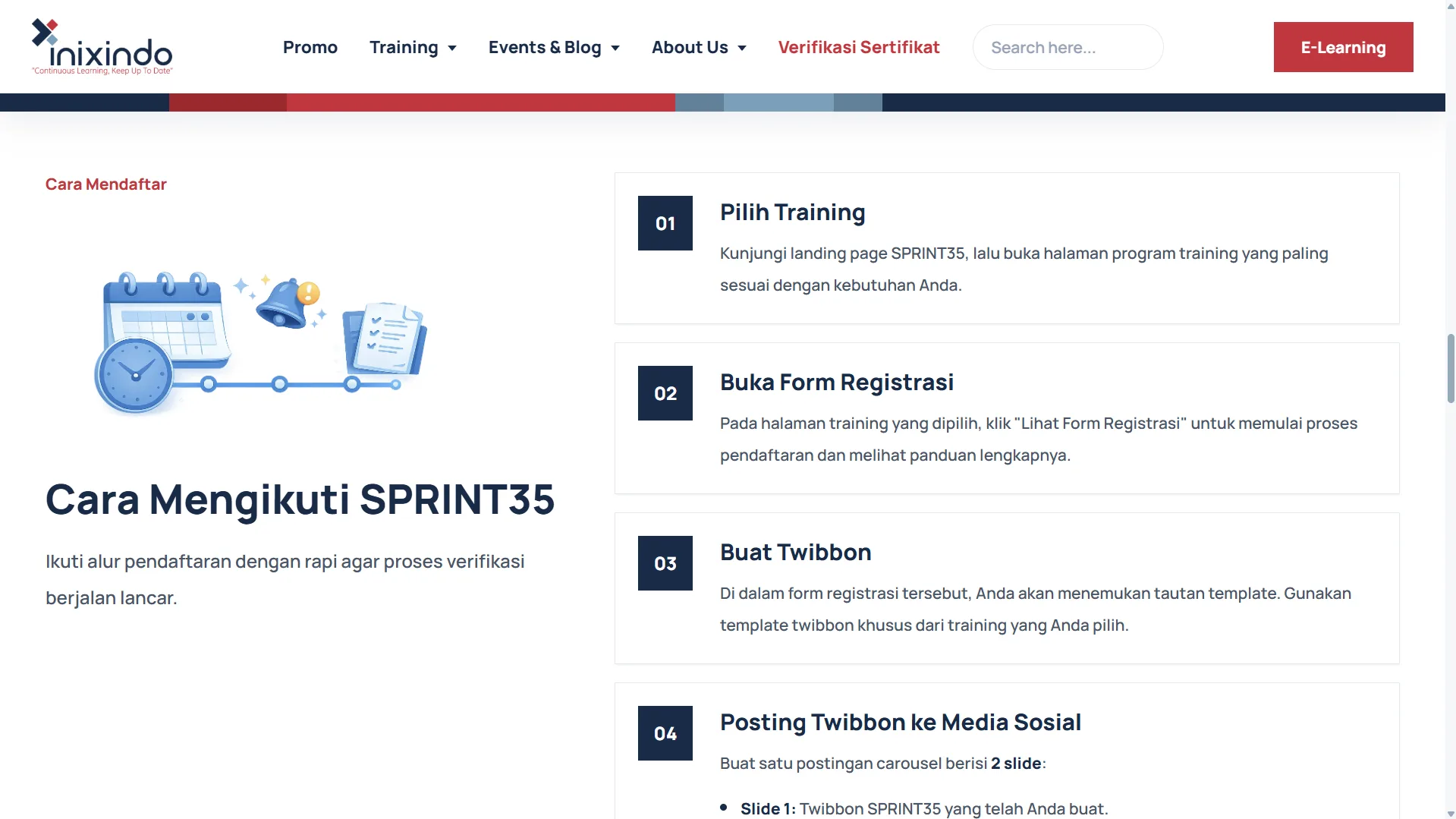
Landing Page dan Sistem Pendaftaran Campaign SPRINT35 Inixindo Pelatihan dan Sertifikasi Gratis (1)

SPRINT35 is a special campaign celebrating Inixindo’s 35th anniversary, combining a promotional landing page with a participant registration system in one connected flow.

In this project, I worked as a Junior Web Developer, handling the implementation of the campaign website, training detail pages, multi-step registration form, data validation, and submission management dashboard.

The system was designed to help participants understand the program, choose a training track, and complete their registration through a simple mobile-friendly flow. On the operational side, submissions can be reviewed, filtered, updated, exported, and followed up through an RSVP workflow after registration.

Scope Summary

  • Campaign landing page development.
  • Training offer detail pages.
  • Responsive implementation for landing pages, training details, registration forms, confirmation pages, and RSVP.
  • Campaign information architecture and conversion flow.
  • Seven-step registration form.
  • Progress indicators, conditional fields, review steps, and validation feedback.
  • Training selection based on the offer page selected by the participant.
  • Server-side registration period validation.
  • Participant data normalization and validation.
  • Duplicate registration prevention.
  • Private file upload and storage handling.
  • Registration number and submission status management.
  • Confirmation page and registration confirmation email.
  • Submission dashboard with search, filters, review, and status updates.
  • CSV export and supporting document management.
  • Participant RSVP workflow.
  • UTM and registration source attribution.
  • SEO metadata, canonical URLs, Open Graph metadata, and indexation rules.
  • Automated testing for public and administrative workflows.

Challenge

Connecting Campaign Awareness to Registration

The landing page could not stop at simply promoting the campaign.

Interested visitors needed to quickly understand the program, available training options, registration mechanism, and what they had to do next.

The experience was therefore structured as:

campaign → training offer → registration form → confirmation

This keeps each stage focused and gives participants enough context before moving forward.

Handling a Registration Window of Only 35 Hours

SPRINT35 had a very short registration period.

A browser countdown alone would not be reliable enough because an old page could remain open or a submission request could be sent directly.

The registration state is therefore also checked on the server. The system distinguishes between upcoming, open, and ended states so the campaign deadline remains consistent regardless of what happens in the browser.

Managing Multiple Training Offers

Each training option has its own topic, schedule, and delivery context.

Instead of asking participants to select a technical identifier or manually type their training choice inside the form, each registration is linked directly to the offer page the participant is viewing.

This simplifies the user experience while keeping submission data more consistent.

Keeping a Long Registration Form Usable

The registration process requires a relatively large amount of participant information.

Presenting everything as one long form would make the experience unnecessarily heavy, particularly on mobile devices.

The form was divided into seven steps with a progress indicator, conditional fields, validation feedback, and a review stage before submission.

This makes the process easier to follow without turning registration into something resembling an annual tax declaration.

Maintaining Reliable Registration Data

Registration data is later used by the operational team, so simply storing whatever the browser sends is not enough.

The system handles data normalization, server-side validation, duplicate prevention, registration numbers, submission statuses, and private file storage so each registration can be tracked consistently.

Making Submissions Actionable for the Operations Team

The workflow does not end when a participant presses Submit.

The internal team still needs to search registrations, review details, group submissions by training or status, update decisions, export records, and manage RSVP responses.

Operational tooling therefore became an important part of the overall implementation

Approach

I divided the SPRINT35 implementation into two connected areas: the public campaign experience and registration operations.

On the public side, the landing page was structured so visitors could quickly understand the most important information. The flow covers the program proposition, registration period, training options, registration mechanism, timeline, important terms, and FAQ before leading users into the application process.

Each training offer has its own detail page. This provides more specific context before the registration form opens, so participants know what they are applying for before entering their information.

The registration form was then divided into seven steps. JavaScript handles step navigation, progress, conditional fields, previews, and early feedback in the browser, while server-side validation remains the final authority before a submission is accepted.

On the backend, campaigns, training offers, and registrations are stored as related data rather than being mixed into a single structure. Submissions are validated and normalized before they are persisted, and the application checks both the campaign period and duplicate registrations.

Supporting documents are stored privately, while each successful submission receives a registration number and status that can be used throughout the next stages of the campaign. Participants are redirected to a confirmation page and receive a registration confirmation email after a successful submission.

For internal operations, I also built a submission management workflow that allows the team to search, filter, review, update, and export registration data without manually processing public form submissions.

The RSVP workflow is handled separately as a post-registration process, allowing participant attendance responses to be recorded and reviewed independently.

For quality assurance, the main flows are covered by automated feature tests including public pages, registration, validation failures, registration deadlines, duplicate prevention, authorization, exports, and RSVP.

Outcome

Campaign & Business Impact

SPRINT35 has a single digital flow connecting campaign information with participant registration.

Visitors can understand the program, explore available training options, review the details, and continue into the correct registration form without moving into a disconnected workflow.

The campaign also does not end when a participant submits the form. Registration data is already structured to support review, status management, exports, and RSVP follow-up.

Technical Impact

Campaigns, training offers, and registrations are separated into related domains so program content is not directly mixed with participant submissions.

Registration deadlines are enforced on both the frontend and server, while duplicate submissions are handled through application validation and data constraints.

Submission and file handling are also designed to maintain consistency when part of the process fails.

The campaign module is covered by automated feature tests across public and operational flows, including registration, validation, deadlines, duplicate prevention, administrative access, exports, and RSVP.

User Experience Impact

Participants can start from the campaign landing page, choose a training program, review its details, and continue into a form that already carries the correct training context.

The seven-step form breaks a relatively large amount of information into a more manageable process.

Progress indicators, validation feedback, a review step, and responsive layouts also help keep the registration experience usable on mobile devices.

Operational Impact

The internal team can review and follow up on submissions through a single workflow.

Registration records can be searched and filtered, participant details reviewed, statuses updated, data exported, and RSVP responses tracked during later campaign stages.

Registration numbers and confirmation emails also provide participants with a clear reference after submitting their application.

Project Detail

SPRINT35 was created as part of Inixindo’s 35th anniversary campaign, offering selected participants access to training and certification programs through a registration period limited to just 35 hours.

The challenge was not simply to build an attractive campaign landing page. Campaign traffic also needed to move through a clear registration journey, from understanding the program and exploring available training options to submitting participant information.

I built the experience as a connected flow. The landing page acts as the main campaign hub, while each training program has its own detail page before participants continue to registration. This gives users enough context about the training they are applying for instead of sending them directly into a long form.

The registration form is divided into seven steps so a relatively large amount of information remains manageable, especially on mobile devices. Important rules are still validated on the server, including the registration period, required information, duplicate submissions, and campaign-specific requirements.

After a successful submission, participants receive a registration number and confirmation. On the operational side, the internal team can review submissions through a dashboard, search and filter participant data, update statuses, export records, and manage RSVP responses for the next stage of the campaign.

My responsibilities included:

  • building the campaign landing page and training detail pages;
  • designing the flow from campaign awareness to registration submission;
  • developing a seven-step registration form;
  • implementing participant data validation and persistence;
  • handling private file uploads and storage;
  • building registration confirmation pages and email notifications;
  • developing the submission management dashboard;
  • implementing the post-registration RSVP workflow;
  • adding SEO metadata, canonical URLs, Open Graph metadata, and UTM attribution;
  • writing automated tests for public flows, validation, deadlines, duplicate submissions, administration, and RSVP.

https://www.inixindo.id/p/campaign/sprint35

VISIT